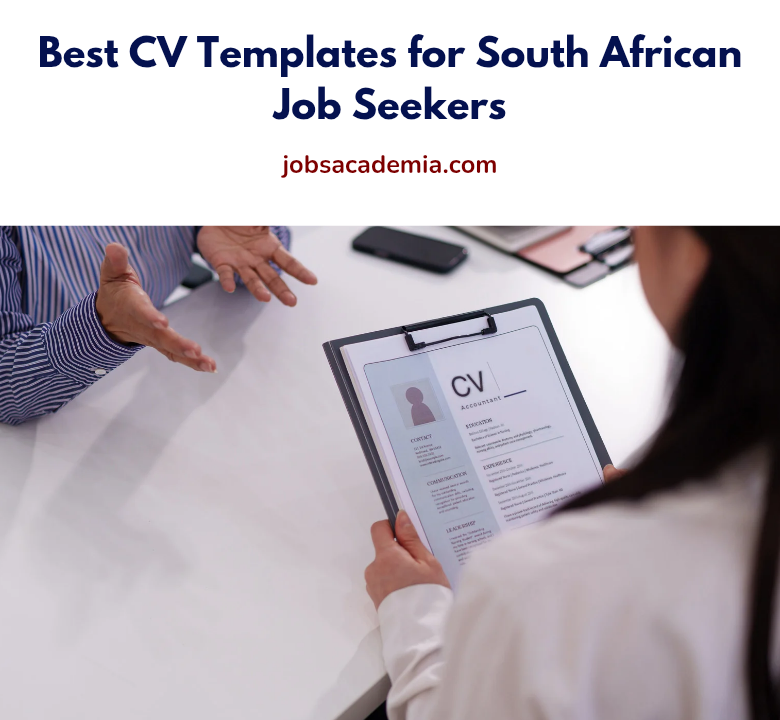
Landing a job in South Africa’s competitive market starts long before the interview. It starts the moment a hiring manager picks up your CV. Whether you’re applying to a Johannesburg corporate, a Cape Town startup, or a government department in Pretoria, your curriculum vitae is your first impression and it needs to be right.
South African CVs follow specific conventions that differ from American résumés or British CVs in several important ways. Understanding what local employers expect, which formats work best for different industries, and how to structure your document can be the difference between a callback and silence.
What Makes a South African CV Different?
Before exploring templates, it helps to understand the local context. South African employers generally expect a more detailed document than the lean one-page American résumé. Two to three pages is the accepted norm for most professionals, and entry-level candidates can comfortably fill one to two pages. Going beyond four pages, however, is considered excessive and can signal poor editing skills.
Unlike in some countries, South African CVs traditionally include personal details such as your ID number, nationality, and equity status particularly for positions at companies that must report on employment equity in terms of the Employment Equity Act. Many large corporates and government entities require this information upfront. Some progressive employers and international companies operating locally are moving away from this practice to reduce unconscious bias, so use your judgement based on the sector and company culture.
A photograph is optional but still common in South Africa, particularly in customer-facing roles and at smaller businesses. If you include one, keep it professional a clean headshot against a neutral background, not a casual photo.
The Five Most Effective CV Templates for South African Job Seekers
1. The Classic Professional Template
This is the gold standard for corporate roles in finance, law, engineering, and the public sector. It’s structured, conservative, and instantly readable.
Structure:
- Personal details (name, contact number, email, address, ID number, nationality, equity status)
- Professional profile or executive summary (three to four lines)
- Core competencies or key skills
- Work experience in reverse chronological order
- Education and qualifications
- Professional memberships and certifications
- References
The classic template uses clean serif or sans-serif fonts like Calibri, Arial, or Garamond at 11 to 12pt. Headings are bolded and slightly larger. There’s ample white space, and the layout is single-column.
This template works exceptionally well for applications to companies like the major South African banks (Standard Bank, Absa, FNB, Nedbank), large auditing firms, law practices, and government departments. Hiring managers in these sectors process hundreds of applications and appreciate documents that follow a familiar structure.
Tip: Your professional profile at the top should be tailored to each role. A generic paragraph that could describe anyone is a wasted opportunity.
2. The Modern Two-Column Template
Popular in marketing, design, technology, and the creative industries, the two-column layout divides your CV into a sidebar and a main content area. Contact details, skills, languages, and certifications sit in a coloured sidebar, while your work experience and education occupy the larger right column.
Why it works in South Africa: The Cape Town tech and creative ecosystem, Johannesburg’s advertising and media sector, and the growing startup landscape across both cities respond well to CVs that demonstrate design awareness. A clean, modern layout signals that you understand visual communication even if you’re not applying for a design role.
Colors to consider: Deep navy, charcoal grey, teal, or forest green project professionalism while standing out from the sea of white-and-black documents. Avoid overly bright colors or trendy gradients that may not print well or render correctly on all screens.
Caution: Two-column PDFs can sometimes confuse Applicant Tracking Systems (ATS) used by large companies. If you’re applying through an online portal, consider whether a simpler, single-column version might be safer for that specific application.
3. The ATS-Optimized Template
Many South African companies particularly multinationals, large retailers, mining houses, and financial services firms use automated ATS software to screen CVs before a human ever reads them. Companies like SAP SuccessFactors and Oracle HCM are widely deployed across the country’s corporate sector.
An ATS-optimized CV strips away tables, text boxes, graphics, and columns in favour of simple, linear text that software can parse accurately. This doesn’t mean it has to look boring careful use of spacing, bold headings, and consistent formatting still creates a professional appearance.
Key principles for ATS success:
- Use standard section headings: “Work Experience,” “Education,” “Skills” not creative alternatives like “My Journey” or “What I Bring”
- Include keywords from the job description naturally within your text
- Save as a .docx file unless the application specifically requests PDF
- Avoid headers and footers for critical information, as some systems skip those areas
- Use bullet points rather than tables to list achievements
This template is essential if you’re targeting roles at Pick n Pay, Shoprite, Discovery, Vodacom, MTN, Sasol, Anglo American, or any other large South African employer with a formal recruitment function.
4. The Academic and Research Template
South Africa has a strong academic sector anchored by institutions like the University of Cape Town, Stellenbosch University, Wits, and UKZN. If you’re applying for academic positions, postdoctoral fellowships, or research roles whether at universities, the CSIR, the NRF, or research NGOs your CV follows an entirely different set of conventions.
Academic CVs are longer (often five to ten pages or more for senior academics), and they prioritise intellectual output over job titles. Key sections include:
- Publications (peer-reviewed articles, book chapters, books)
- Conference presentations
- Research grants and funding secured
- Postgraduate students supervised
- Teaching responsibilities
- Community engagement and service
The format here is functional rather than decorative. Chronological listings within each category, with the most recent entries first, are standard. The document should demonstrate depth of scholarship and contribution to the field rather than visual flair.
5. The Skills-Based (Functional) Template
This template is ideal for career changers, recent graduates with limited formal work experience, people returning to work after a gap, and contract or freelance workers whose experience doesn’t fit neatly into a traditional chronological format.
Rather than listing jobs in order, a functional CV groups experience under competency headings for example, Project Management, Client Relations, Financial Administration, or Technical Support. Under each heading, you draw on examples from various roles, volunteer work, freelance projects, or academic experience to demonstrate capability.
When it works in South Africa: The country’s high youth unemployment rate means many talented job seekers simply haven’t had the opportunity to build a long employment history. A skills-based CV lets a recent TVET college graduate or university leaver lead with what they can actually do, rather than highlighting a short work history.
Potential drawback: Some South African recruiters remain sceptical of functional CVs, associating them with candidates trying to hide gaps or instability. To counter this, include a brief chronological summary at the end of the document so the timeline is still visible.
Universal CV Best Practices for South African Job Seekers
Regardless of which template you choose, certain principles apply universally in the local context.
Language and tone: English is the primary language of business CVs across South Africa, even if the working language of a particular role may be Afrikaans or another official language. Write in clear, formal English and proofread meticulously spelling errors and grammatical mistakes are cited consistently as reasons for rejection by South African HR professionals.
Quantify your achievements: “Managed a team” is far weaker than “Managed a team of 12 across three provinces, delivering a R4.2 million infrastructure project on time and 8% under budget.” South African employers respond well to specific, measurable evidence of impact.
Quantify your achievements: “Managed a team” is far weaker than “Managed a team of 12 across three provinces, delivering a R4.2 million infrastructure project on time and 8% under budget.” South African employers respond well to specific, measurable evidence of impact.
References: The standard practice in South Africa is to list two or three professional references by name and contact detail at the end of your CV. The phrase “references available on request” is gradually falling out of favour providing the details directly saves time and signals transparency. Always obtain permission from your referees before listing them.
File format and naming: Save your CV as a PDF to preserve formatting, unless instructions specify otherwise. Name the file professionally: FirstnameLastname_CV.pdf, not Document1.pdf or MyCVFinal_v3.pdf.
Social media: Include a LinkedIn profile URL if it is up to date and consistent with your CV. In technical and creative fields, links to a GitHub profile or an online portfolio are increasingly expected.
Choosing the Right Template for Your Industry
| Industry | Recommended Template |
|---|---|
| Banking and Finance | Classic Professional or ATS-Optimised |
| Technology and IT | Modern Two-Column or ATS-Optimised |
| Creative and Marketing | Modern Two-Column |
| Government and Public Sector | Classic Professional |
| Mining and Engineering | Classic Professional or ATS-Optimised |
| Academia and Research | Academic/Research |
| Recent Graduates | Skills-Based or Classic Professional |
| Retail and FMCG | ATS-Optimised |
Final Thoughts
Your CV is a living document, not a once-off task. The most effective South African job seekers maintain a master CV with all their experience recorded in detail, and then create tailored, trimmed versions for each application. Matching the language and priorities of each job description without being dishonest shows a recruiter that you understand the role and have taken the time to communicate that clearly.
The right template won’t write your CV for you, but it will give your experience the structure and visual credibility it deserves. Start with a format suited to your industry and career stage, apply the principles above, and remember that in South Africa’s hiring landscape, a well-presented, carefully written CV remains one of the most powerful tools at your disposal.